

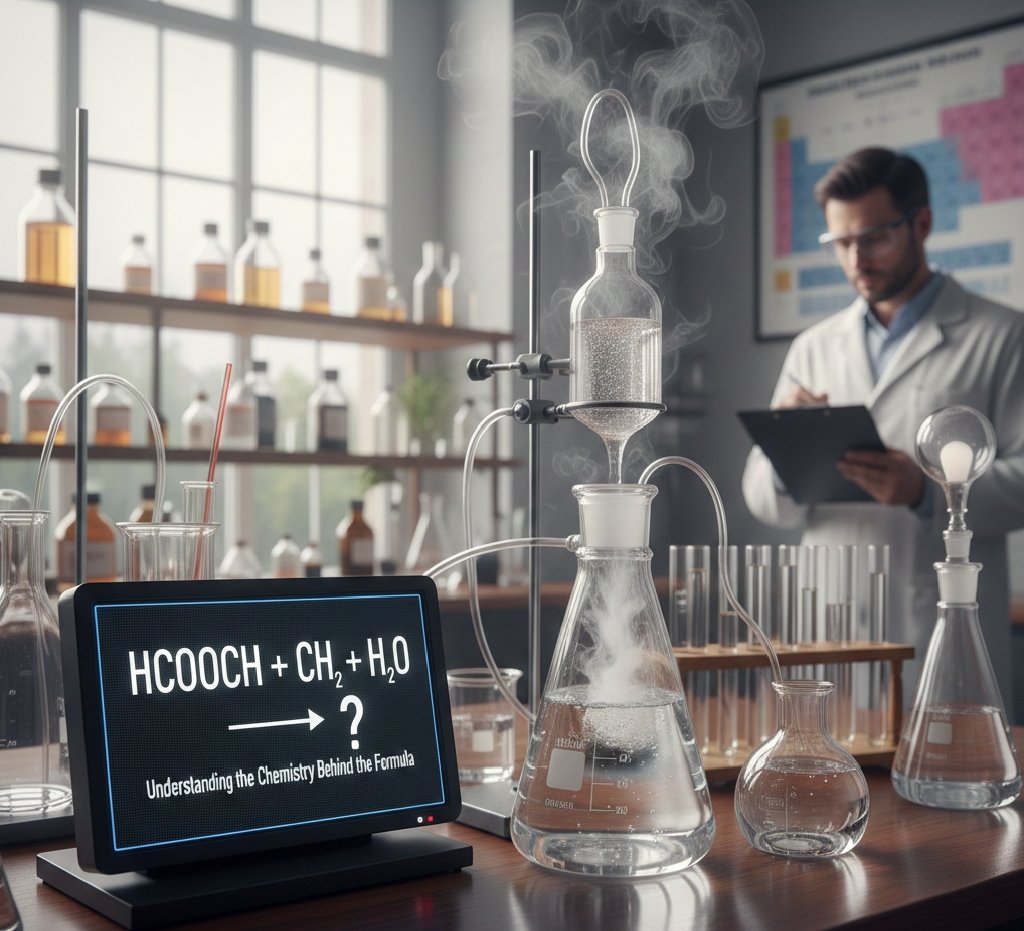
The chemical expression “HCOOCH CH₂ H₂O” often appears in discussions related to organic chemistry, hydrolysis reactions, and the behavior of different functional groups. While the formula may look confusing at first, it represents key components involved in reactions that shape many industrial, biological, and laboratory processes. This simple and clear guide breaks down the formula, its meaning, and its applications.
What Does HCOOCH CH₂ H₂O Represent?
The expression includes three parts:
- HCOOCH – a fragment resembling a formate ester
- CH₂ – a methylene group commonly found in organic compounds
- H₂O – water, often involved in hydrolysis reactions
While not a complete standalone molecular formula, these fragments often appear in hydrolysis, ester reactions, and organic synthesis.
In simple terms:
It represents components typically involved in breaking down esters or forming new organic compounds under aqueous conditions.
Breaking Down Each Component
1. HCOOCH – The Ester Fragment
This part resembles the structure of a formate ester, commonly found in:
- Organic solvents
- Resins
- Fragrances
- Industrial chemicals
Esters react easily with water, especially in acidic or basic environments.
2. CH₂ – The Building Block of Organic Chemistry
CH₂ (methylene) is part of:
- Chains of hydrocarbons
- Alcohols
- Acids
- Synthetic polymers
It helps form the backbone of countless organic compounds.
3. H₂O – The Universal Reactant
Water is essential in:
- Hydrolysis
- Combustion
- Acid–base reactions
- Biological metabolism
In ester reactions, water breaks chemical bonds to form alcohols and acids.
How These Components Interact
Hydrolysis is the key reaction.
When an ester (represented by HCOOCH) comes in contact with water (H₂O), the molecule typically breaks down.
General ester hydrolysis reaction:
- Ester + Water
- → Acid + Alcohol
If CH₂ is part of the organic chain, the resulting products may include:
- Formic acid derivatives
- Alcohols containing CH₂ groups
Applications in Real-Life Chemistry
1. Industrial Processes
These reactions are important for producing:
- Plasticizers
- Coatings
- Adhesives
- Pharmaceutical ingredients
2. Biological Chemistry
Hydrolysis is central to:
- Digestion of fats (which are esters)
- Breakdown of metabolic compounds
- Cellular energy release
3. Laboratory Synthesis
Chemists use such reactions to:
- Prepare alcohols
- Modify organic molecules
- Study reactivity
Why Understanding This Formula Matters
Even though “HCOOCH CH₂ H₂O” is not a classical single compound, it teaches important concepts:
Key benefits for learners:
- Helps identify ester structures
- Builds understanding of hydrolysis
- Connects organic fragments to real chemical reactions
- Enhances problem-solving in synthetic chemistry
Common Misinterpretations
Some may think the formula represents:
- A single molecule
- A complete balanced reaction
Read More: Infinity Tesimal: Understanding a Concept Beyond Limits
Conclusion
“HCOOCH CH₂ H₂O” highlights essential building blocks of organic chemistry. Together, they represent how esters interact with water to form new compounds through hydrolysis. Understanding these components helps students and professionals grasp key chemical principles that are widely used in laboratories, industries, and biological systems.
